How to Build a Signal Fire for Wilderness Rescue

Most people build a signal fire like they’re making a backyard bonfire with panic added. That’s how you get a little smoke trapped under trees, wet fuel hissing on the edges, and a fire you can’t control once the wind shifts. A rescue fire has one job: make you visible without creating a second emergency.
The trick isn’t just smoke. Smoke that nobody can see is wasted effort. Flame that eats your whole woodpile before aircraft or ground teams are near is wasted fuel. A signal fire is a staged system: location, fire lay, dry ignition, smoky fuel, wind management, and a shutdown plan before the first spark hits the tinder bundle.
Where should you build a signal fire?
Build it where smoke and flame can be seen from the route rescuers are most likely to use, not where it’s most comfortable to sit. Visibility beats convenience every time.
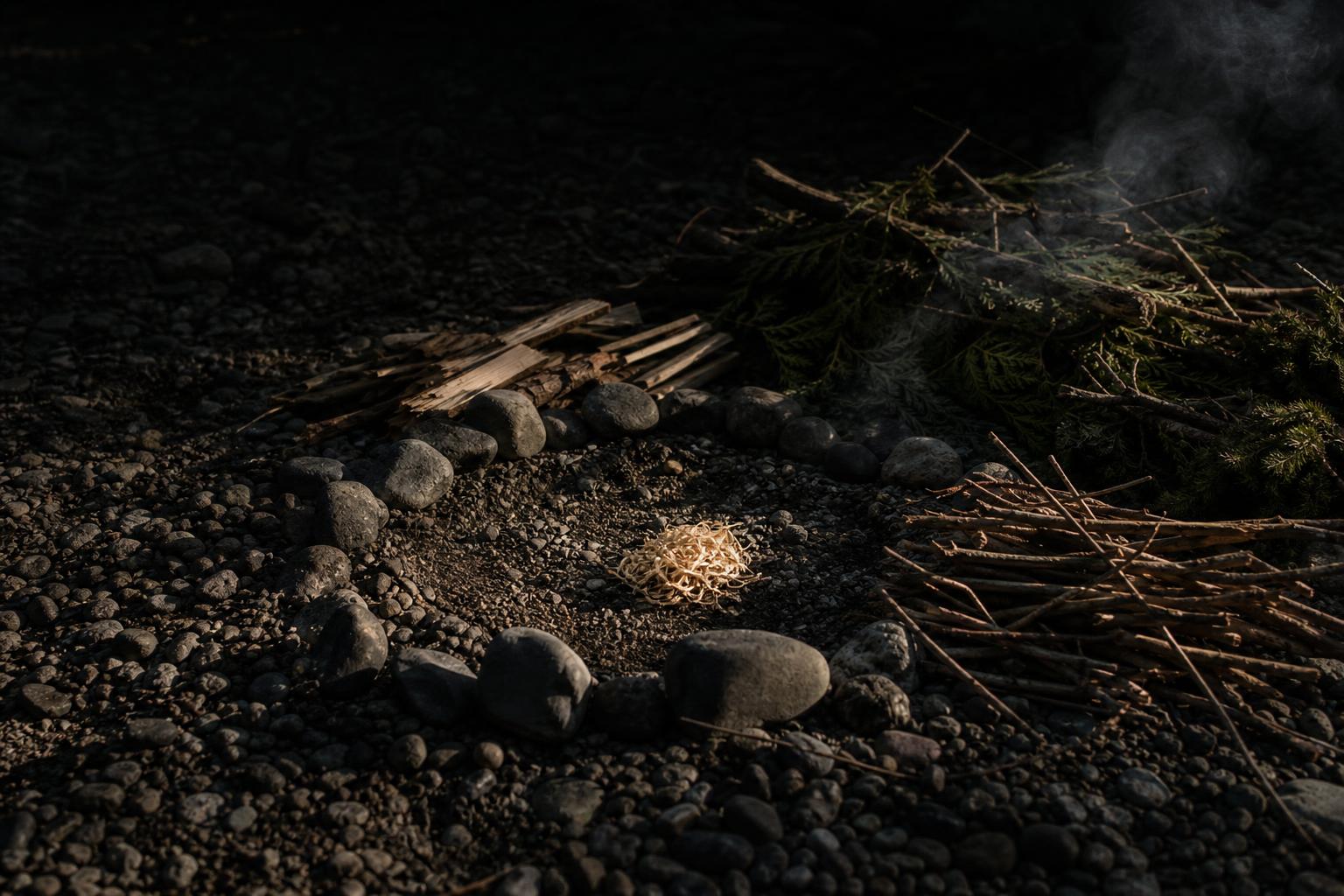
The best site is open, high-contrast, and defensible. A gravel bar, lakeshore, rock slab, sand flat, wide meadow edge, snow-cleared opening, or bare mineral soil beats a cozy spot under timber. Tree cover hides smoke from aircraft. Brush hides flame from ground searchers. A hollow can trap smoke until it spreads into useless haze.
Bad blogs tell you to climb to the highest ridge and light up. That’s half advice and half arson recipe. A ridge can be excellent if it’s rocky, bare, and you can control the fire. A dry grass ridge in wind is not a signal platform. It’s a fuse.
Pick a place that gives you three things:
- Open sky above the fire. Smoke needs a clean vertical path before wind bends it.
- Contrast behind the smoke. White smoke shows better against dark timber or shaded rock. Flame shows better at dusk, night, and against snow or open ground.
- A safe working zone. Clear duff, leaves, needles, grass, and twigs down to mineral soil for at least 10 feet around the fire, more if wind is pushing sparks.
Do not build on peat, deep duff, rotten root mats, or stump holes. Ground fire can creep where you can’t see it. Don’t build tight against boulders with dry grass tucked behind them. Don’t build under low limbs. Don’t build where smoke will blow straight into your shelter and force you to abandon your own camp.
The U.S. Forest Service fire guidance is blunt for a reason: know current restrictions, use proper sites, and keep fire from escaping. A rescue situation changes priorities, not physics. Dry fuel, wind, slope, and embers still behave like dry fuel, wind, slope, and embers.
How big should a rescue signal fire be?
A rescue fire should be as small as you can keep it while still producing a strong visible column. Big uncontrolled flames waste fuel, scatter embers, and force you to back away from the only tool you have.
Start with a core fire about the size of a dinner plate to a small washtub. That sounds underwhelming to people who think survival means theatrical flames. They’re wrong. A compact hot core lights reliably, consumes fuel efficiently, and lets you add smoke material when you actually need smoke.
The fire lay matters more than the footprint. A lazy pile of damp sticks makes steam, not a signal. Build a hot fire first, then make smoke on top of heat. Fire needs a proper fuel ladder:
- Tinder bundle: dry fibers that catch from spark or flame, such as dry grass, shredded bark, feathered wood shavings, seed fluff mixed with dry scrapings, or prepared fire starter.
- Fine kindling: matchstick to pencil-lead thickness, bone dry, enough to make the tinder irrelevant after the first minute.
- Small kindling: pencil to thumb thickness, split if possible, stacked where it can breathe.
- Fuel sticks: thumb to wrist thickness for building a coal base and sustaining heat under smoke material.
- Smoke fuel: green leafy branches, damp grass, green conifer boughs, or punky damp wood added only after the core is burning hot.
If your tinder feels cool against the back of your hand, it’s still too damp. Dry tinder feels neutral or slightly warm. Damp tinder steals heat before it ignites, then people scrape harder, blow harder, and blame the striker. The tinder was the problem.
A teepee lay throws flame fast but can collapse and smother itself. A small log-cabin lay breathes better and leaves a stable pocket for the tinder bundle. For a signal fire, I like a hybrid: tinder in the center, pencil kindling leaned loosely over it, thumb-thick sticks in a square around that, and wrist-thick fuel staged within reach but not thrown on until the flame is established. If you don’t already have basic fire structure dialed in, read our field guide on how to build a campfire before you pretend smoke is the hard part.
Should you build one signal fire or three?
One strong, controllable signal fire is better than three weak smoking messes. Three fires in a clear pattern can draw attention, but only if you have fuel, time, safe spacing, and the ability to control all of them.
The classic three-fire pattern gets repeated because repeated groups of three are widely associated with distress. Fine. Use it if conditions support it. Three fires in a triangle on a gravel bar or snowfield can stand out from an ordinary campfire. Three fires in dry brush with one tired survivor and a water bottle is stupid.
If you choose the three-fire layout, separate the fires far enough that one doesn’t ignite the next by radiant heat or rolling fuel. Keep the pattern obvious from above: triangle, straight line, or three distinct columns with cleared ground around each. Do not scatter them randomly. Random smoke looks like random campers, a brush fire, or nothing at all.
Most of the time, the better move is one prepared main fire and two unlit signal piles nearby. Keep them ready. If aircraft circle, if voices get close, or if you hear engines, light the main fire and smoke it hard. If you have help and safe ground, light the others. Survival rewards timing. It does not reward burning all your tinder while the search aircraft is still 20 miles away.
How do you make a signal fire smoke?
Make smoke by adding green or damp organic material onto an already hot flame bed. Wet material alone doesn’t signal, it smolders, hisses, and dies.
White smoke usually comes from water-rich plant material and damp vegetation. Green boughs, leafy branches, damp grass, and punky rotten wood can produce a thick smoke column when laid across a hot core. The mistake is adding too much at once. A heavy wet mat cuts oxygen. Then your fire goes from signal to compost pile.
Add smoke fuel in layers. Put on a loose armload, wait for it to smoke, then feed more as the flame punches through. Leave intake gaps on the windward side. If the smoke thins, add more green material. If the fire chokes, pull some off with a stick and rebuild heat with dry kindling.
Fuel selection matters. Don’t burn poison ivy, poison oak, poison sumac, treated lumber, plastic, rubber, or mystery trash as your smoke plan. Breathing toxic smoke while already cold, dehydrated, injured, or lost is not clever. Thick smoke is useful only if you can stay functional around it.
In wet country, your smoke fuel is everywhere, but your heat fuel is the bottleneck. Split dead branches to reach the drier interior. Look under logs, under dense conifers, inside standing dead wood, and beneath bark that sheds rain. Keep your finest kindling inside your jacket or under a hat until ignition. The field techniques in making fire in rain apply directly here, because a wet-weather signal fire still starts as a dry ignition problem.
How do you keep smoke visible in wind?
Use wind instead of fighting it: build where the smoke can rise first, then drift across open background. If wind flattens the smoke into brush or trees, move the signal site or change the shape of the fire.
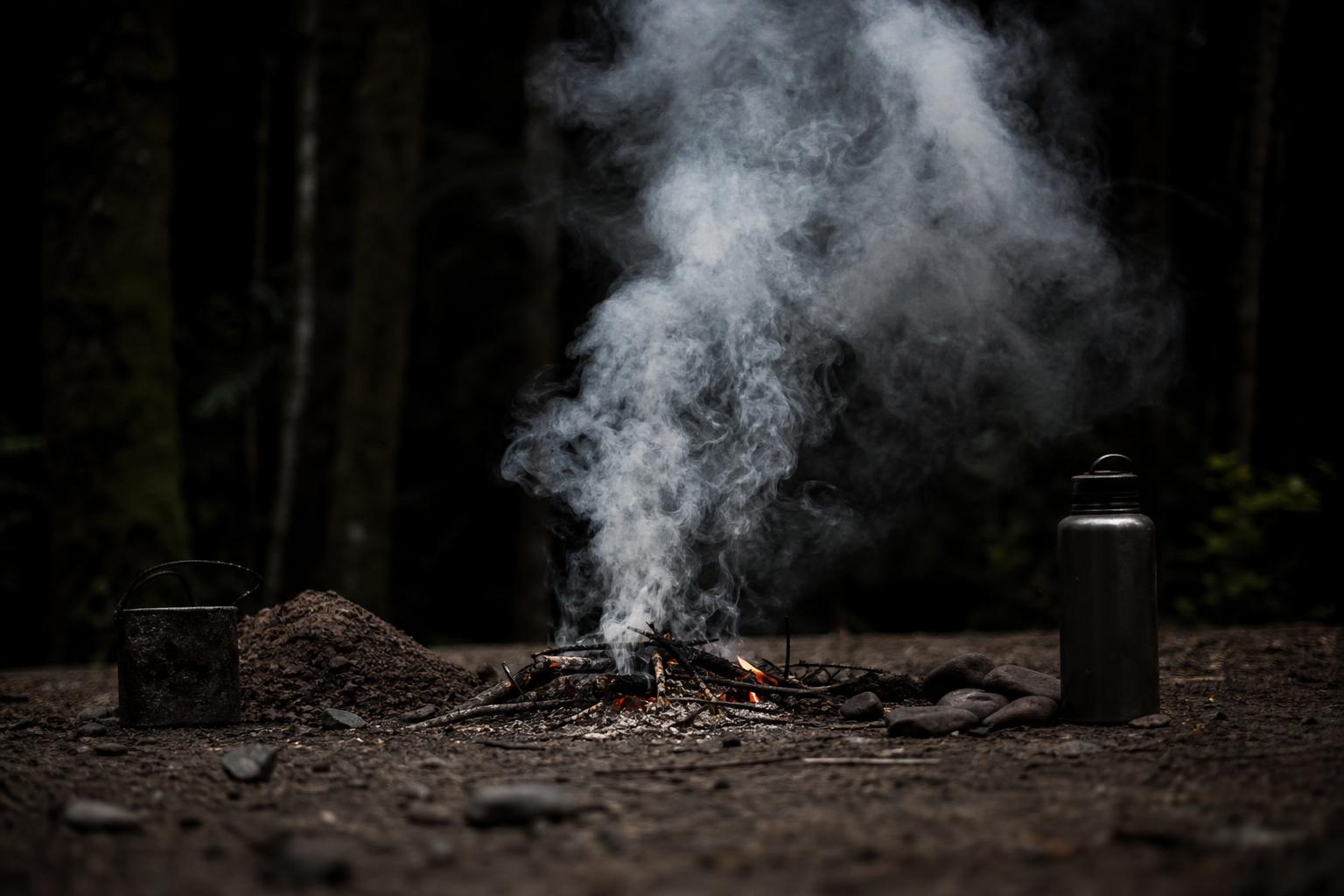
Light wind can help a signal by stretching smoke into a long visible streamer. Heavy wind can shred the column, drive embers, and turn a safe fire into a problem. Your job is to keep the fire hot, low, fed from the upwind side, and protected enough that the coal bed survives.
A simple windbreak helps, but only if it doesn’t become fuel. Use rock, dirt, snow blocks, or large green logs laid well outside the flame. Don’t build a cute wall of dry sticks and call it a windscreen. That’s kindling with a job title.
In steady wind, set the tinder and fine kindling slightly downwind of the first flame so heat pushes through the fuel instead of away from it. Feed dry sticks from the windward side. Add smoke fuel across the top like a loose roof, not like a sealed lid. The open side should face into the breeze enough to keep oxygen moving.
If smoke hugs the ground, you’re probably in cold air drainage, a depression, or a wind shadow. Move upslope to a more open bench if it’s safe. If you can’t move, use more flame and less wet fuel until the column lifts. A smoky pile with no heat doesn’t climb.
When should you light a signal fire?
Light it when someone can plausibly see it, or when the smoke itself is your best chance of attracting distant help. Burning scarce fuel all day without a target is usually bad fire discipline.
Good trigger moments include aircraft noise, vehicle noise, voices, search whistles, dusk when flame becomes visible, or clear weather after a storm. If you’re in a known search area and have enough fuel, a daytime smoke column can be worth maintaining. If you’re alone with limited wood, stage the fire and wait for a higher-probability moment.
Keep ignition ready. This is where people fail under stress. The fire lay should be built before you need it. Tinder should be dry and covered. Kindling should be split, sorted, and within arm’s reach. Smoke fuel should be piled nearby, not collected after you hear a helicopter.
Use a cover if weather is working against you. A bark slab, poncho edge, pack lid, or evergreen bough roof can protect the tinder and fine kindling until ignition. Keep the cover high enough and far enough away that you don’t light your shelter material on fire. Obvious, apparently not obvious enough.
How do you control a survival fire without losing the signal?
Control comes from clearing the ground, staging water or dirt, feeding deliberately, and never building more fire than you can shut down. A signal fire you can’t approach is no longer a tool.
Before ignition, place your control materials. Water is best. Dirt and sand help smother edges. A digging stick, flat rock, pot, or boot heel can break up coals. Green branches can drag burning pieces back into the ring, though they can also ignite if you get lazy.
Keep fuel piles uphill and upwind from the flame if the terrain allows. Sparks move with wind. Burning sticks roll downhill. Put your dry tinder and reserve kindling far enough from the fire that one gust doesn’t erase tomorrow’s fire-starting ability.
The National Park Service gives the standard campfire shutdown for a reason: drown, stir, and feel for heat before leaving. Their campfire safety guidance also warns against leaving fires unattended. In rescue use, unattended is how your signal becomes the thing crews have to suppress.
Shut the fire down in stages. Stop adding smoke fuel. Burn remaining dry sticks down to coals. Spread the coals inside the cleared ring, not outside it. Add water slowly to avoid steam burns, stir, expose hot pockets, then add more. If you’re using dirt, mix it into the coals until no glow remains. Feel above the ashes with the back of your hand first, then closer. If you can feel heat, it isn’t out.
What should you do if a fire is unsafe?
Use non-fire signals first when wind, drought, fuel, terrain, or injury make a signal fire likely to escape. Rescue signaling is not married to flame.
Fire is powerful because smoke rises and flame moves. Those are also the reasons it gets people in trouble. If you’re in dry grass during high wind, deep forest duff with no water, a posted fire-restriction area, or a slope filled with ladder fuels, don’t treat a match like a rescue plan.
Use contrast and repetition instead:
- Lay out bright clothing, reflective gear, sleeping pads, tarps, or emergency blankets in an open area.
- Build large ground symbols from rocks, logs, branches, or disturbed snow.
- Use a whistle in repeated groups of three.
- Flash a mirror, phone screen, headlamp, or metal pot toward aircraft or ridgelines.
- Move to open ground if you can do it without losing shelter, water, or your known position.
If you already have a campfire for warmth and conditions are marginal, don’t automatically convert it into a smoke monster. Keep it small. Make nearby visual signals. Save your strength. A firefighter can smell the difference between survival judgment and internet advice.
FAQ
What fuel makes the best smoke for a signal fire?
Green leafy branches, damp grass, green conifer boughs, and punky damp wood make good smoke when added over a hot fire. They work because the burning core supplies heat while the moist material produces visible smoke.
Can you use a signal fire at night?
Yes. At night, flame and glowing movement can be more visible than smoke, especially from higher ground or open shorelines. Keep the fire controlled and use brief bursts of brighter flame when you hear aircraft, vehicles, or searchers.
Is three fires always better than one?
No. Three fires are better only when the pattern is obvious and every fire can be controlled. One hot, smoky, well-placed fire beats three weak fires that waste fuel or spread into surrounding vegetation.
Build the fire before panic gets a vote
A real signal fire is built backward from rescue: where it can be seen, how smoke will travel, what fuel is staged, how fast it can be lit, and how completely it can be killed. Smoke is the visible part. Discipline is the part that keeps you alive long enough for it to matter.
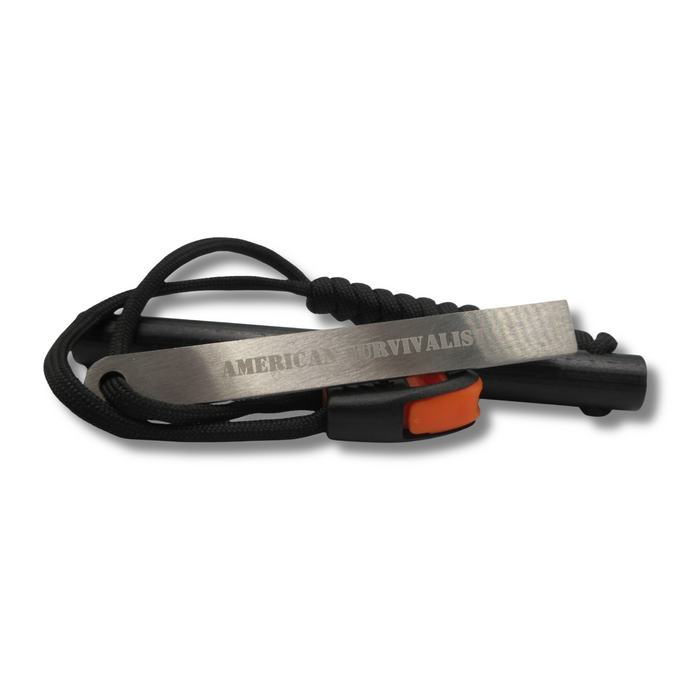
For the wider survival skills that support this, grab the free American Survivalist survival guides and put the fire, shelter, water, and signaling pieces together before you’re cold and guessing. If fire is part of your emergency kit, carry ignition that works after your matches are gone, our 5-inch American Survivalist ferro rod and striker gives you a half-inch solid ferrocerium rod, hardened 90-degree striker, and 15,000+ strikes worth of chances to light the signal you already built right.